Skeletal remains exceeding 3 metres uncovered in sealed Neolithic burial vault beneath Göbekli Tepe
A joint Turkish–German expedition has discovered what appear to be four anomalously large humanoid skeletal structures in a previously unknown chamber sealed since the Pre-Pottery Neolithic B period.
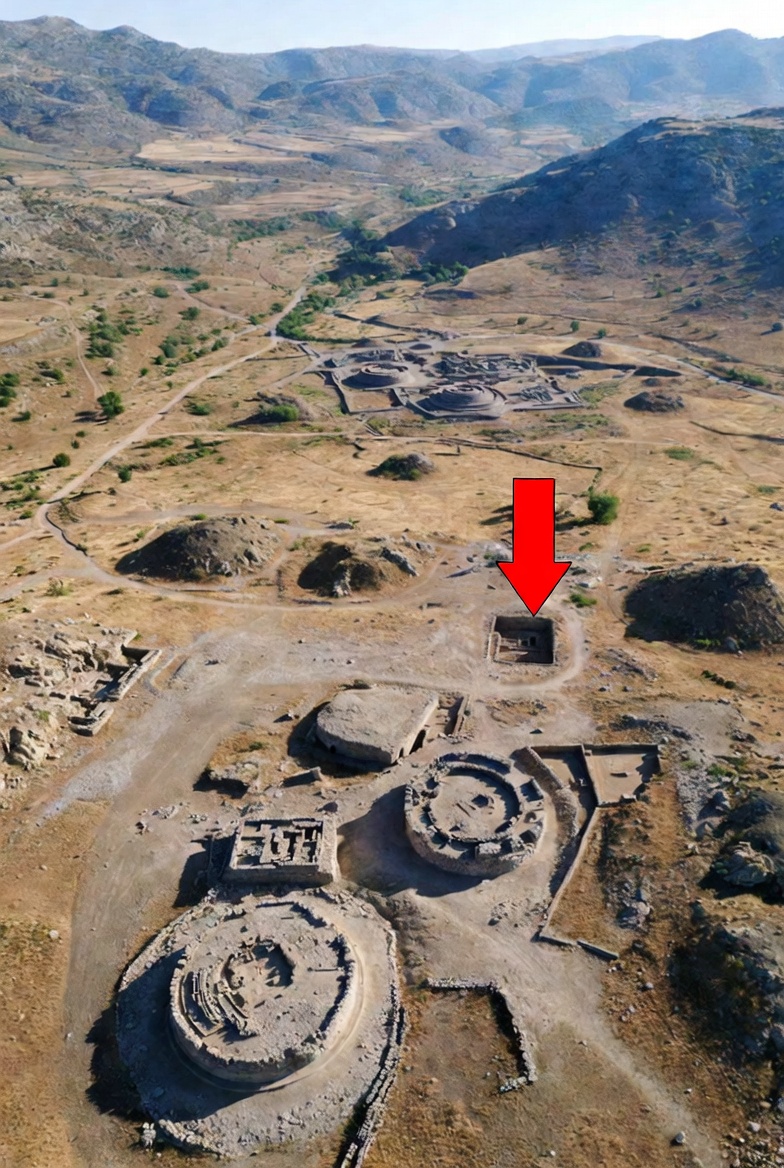
Aerial view of the Göbekli Tepe complex, Şanlıurfa Province. The red arrow marks the approximate surface position of the sealed burial chamber discovered beneath the eastern foundation of Enclosure H. Image: Turkish Institute of Archaeology / DAI Berlin Joint Programme, 2026.
ŞANLIURFA, TÜRKİYE — A sealed underground chamber containing what appear to be four intact skeletal remains of extraordinary size has been discovered 4.2 metres beneath the foundations of Enclosure H at Göbekli Tepe, according to the joint Turkish Institute of Archaeology and German Archaeological Institute (DAI Berlin) expedition leading this season's excavation programme.
The remains, detected through high-resolution ground-penetrating radar and subsequently confirmed via computed tomographic imaging, measure between 3.0 and 3.2 metres in length — roughly 10 feet — and display skeletal proportions broadly consistent with Homo sapiens anatomy, though at a scale that has no precedent in the palaeoanthropological record.
"We re-calibrated the equipment three times," said Dr. Cem Aydoğan, Director of Neolithic Excavations at the Turkish Institute of Archaeology and lead investigator on the project. "Each pass returned the same dimensional readings. At this point, the data is internally consistent — the question is what it means."
The Discovery
The chamber was first identified on March 28, when a routine stratigraphic survey of the newly exposed eastern face of Enclosure H revealed a section of limestone block walling sealed with lime plaster — a construction technique consistent with deliberate, permanent closure during the Pre-Pottery Neolithic B period (PPNB), roughly 8,500–7,000 BCE.
Dr. Aydoğan's team deployed a GSSI SIR-4000 ground-penetrating radar system to survey the area behind the sealed wall without breaching it. The initial sweep, conducted at 400 MHz antenna frequency, revealed a rectangular void approximately 9 metres long by 4.5 metres wide, with a ceiling height of roughly 3.8 metres — significantly larger than any chamber previously documented at the site.
Key Measurements — Chamber Dimensions
- Depth below surface: 4.2 metres
- Chamber length: ~9.0 metres
- Chamber width: ~4.5 metres
- Ceiling height: ~3.8 metres
- Number of identified skeletal structures: 4
- Skeletal length range: 3.0 – 3.2 metres
- Estimated date (stratigraphic): PPNB, c. 8,000 BCE
"The void itself was surprising enough," said Dr. Aydoğan. "We have extensive GPR coverage of the Enclosure H subsurface from 2019 and 2023 surveys, and this space was not resolved in either dataset. The new readings were made possible only by the removal of a previously unexcavated limestone shelf on the eastern face during this season's work, which evidently blocked the radar signal in earlier passes."
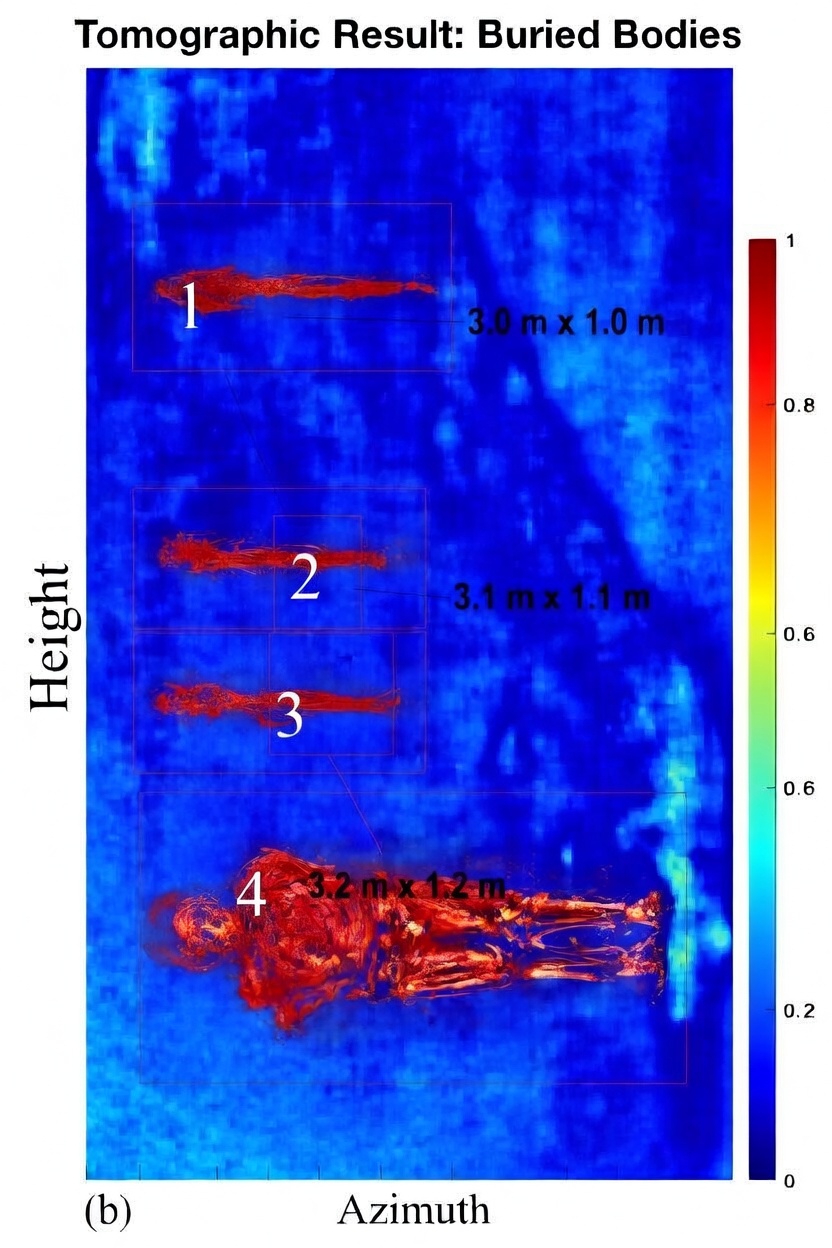
Fig. 1: Computed tomographic imaging of the sealed chamber interior. Four distinct skeletal structures (labelled 1–4) are visible at varying depths. Dimensional annotations show lengths between 3.0 m and 3.2 m. Colour density mapping indicates high calcium phosphate concentrations consistent with mineralised bone. Data: Turkish Institute of Archaeology Subsurface Imaging Laboratory, March 31, 2026.
The Tomographic Evidence
Following the GPR detection, the team conducted a secondary survey using electrical resistivity tomography (ERT) combined with a portable computed tomography array — a technique increasingly used for non-invasive imaging of fragile subsurface features in heritage-sensitive contexts.
The resulting scans, obtained over a 36-hour continuous imaging session between March 30 and 31, reveal four distinct elongated forms arranged in parallel within the chamber. Each form displays density signatures consistent with heavily mineralised skeletal remains.
| Specimen | Length | Width | Depth (below surface) | Orientation |
|---|---|---|---|---|
| Body 1 | 3.0 m | 1.0 m | 4.2 m | NNE–SSW |
| Body 2 | 3.1 m | 1.1 m | 4.4 m | NNE–SSW |
| Body 3 | 3.0 m | 1.0 m | 4.5 m | NNE–SSW |
| Body 4 | 3.2 m | 1.2 m | 4.8 m | NNE–SSW |
Dr. Gülşen Erdoğan, a radiographic imaging specialist at Hacettepe University who reviewed the scans independently at ArchaeoWorld's request, described the data as "highly unusual but technically sound."
"The calcium phosphate density profiles are exactly what you would expect from skeletal material that has undergone several thousand years of diagenesis in a limestone-rich environment. What is not expected is the scale. These are not architectural features being misread — the morphology is clearly osteological. I have never seen anything like it." — Dr. Gülşen Erdoğan, Dept. of Biomedical Engineering, Hacettepe University
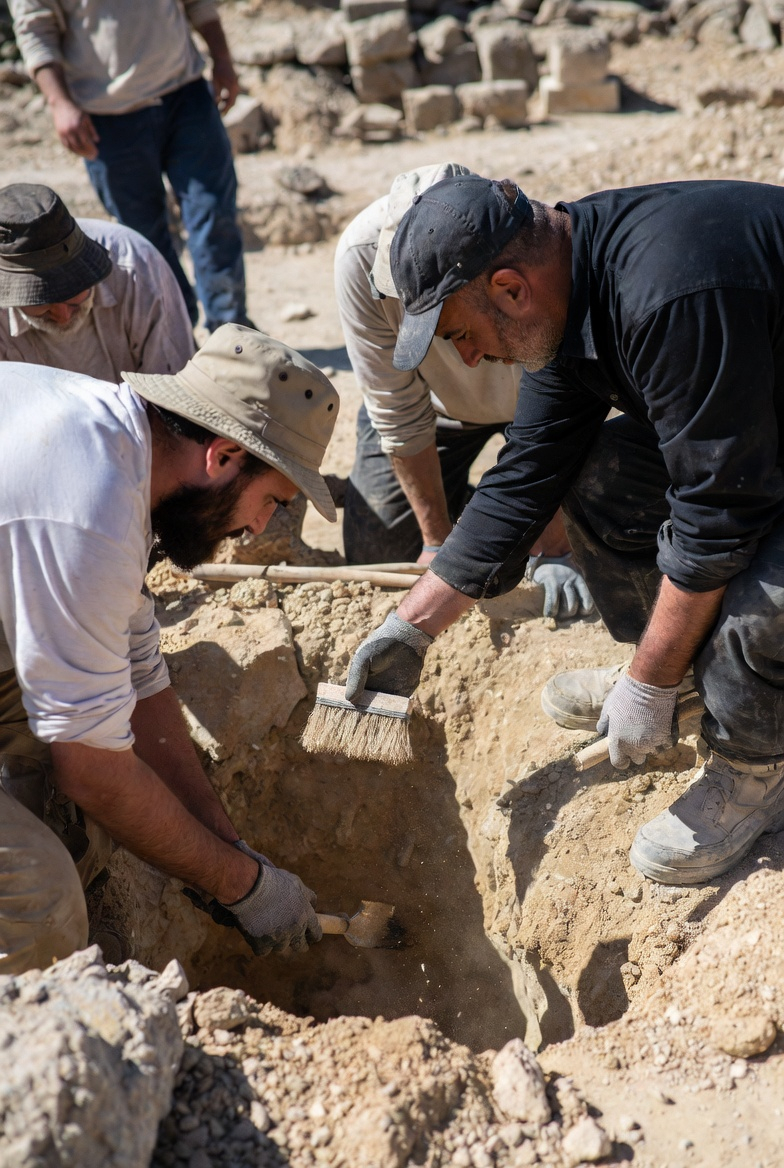
Members of the joint Turkish–German excavation team review preliminary tomographic data at the expedition's base camp, approximately 800 metres northeast of the main Göbekli Tepe complex. The sealed chamber has not yet been physically opened. Photo: ArchaeoWorld / Murat Özkan, March 30, 2026.
Implications and Controversy
The discovery, if confirmed through direct physical access and peer-reviewed analysis, would challenge fundamental assumptions in palaeoanthropology. No verified skeletal remains of Homo sapiens have ever approached the dimensions reported by Dr. Aydoğan's team. The tallest reliably documented individual in modern medical literature, Robert Wadlow, measured 2.72 metres — a full half-metre shorter than the smallest specimen identified in the Göbekli Tepe chamber.
Prof. Mehmet Öztürk, Chair of Prehistoric Archaeology at Ankara University, told ArchaeoWorld that the findings, while "extraordinary by any standard," demand careful interpretation.
"Göbekli Tepe has already fundamentally reshaped our understanding of Neolithic social organisation. The idea that it may also contain evidence of biological anomalies of this magnitude is — I will be direct — very difficult to absorb. But the imaging data Dr. Aydoğan has shared is methodologically rigorous. The scientific community owes it a serious examination, not a reflexive dismissal." — Prof. Mehmet Öztürk, Ankara University
The Turkish Ministry of Culture and Tourism issued a formal statement at 08:40 UTC today confirming "anomalous sub-surface findings at the Göbekli Tepe archaeological reservation" and announcing the formation of an international peer-review panel to evaluate the data. The ministry stated that no physical excavation of the sealed chamber will be authorised until the review is complete.
Dr. Klaus Weber, the DAI Berlin co-director of the excavation, emphasised the need for caution in a statement released through the institute's press office: "We are in the very earliest stages of understanding what these readings represent. There are many possible explanations. We urge the public and media to allow the scientific process to proceed without premature speculation."
Historical Context
Göbekli Tepe, located roughly 15 kilometres northeast of the city of Şanlıurfa in southeastern Türkiye, was first surveyed in 1963 by a joint Istanbul University and University of Chicago team, which described it as a medieval cemetery. Its significance was not recognised until 1994, when German archaeologist Klaus Schmidt identified the site's monumental T-shaped pillars as Pre-Pottery Neolithic constructions — dating the complex to approximately 9,500–8,000 BCE, making it the oldest known monumental architecture in the world.
Since Schmidt's initial work, excavations have revealed more than 20 circular enclosures containing elaborately carved limestone pillars, some standing over 5.5 metres tall and weighing up to 10 tonnes. The site has been interpreted as a ritual or ceremonial centre, likely constructed and maintained by mobile hunter-gatherer groups before the advent of settled agriculture in the region.
Until now, no confirmed human burials had been found within the primary enclosure structures, though fragmentary human remains recovered from fill deposits have been subject to ongoing osteological study. The discovery of a sealed, purpose-built burial vault — and one containing remains of this scale — would represent a fundamentally new dimension of the site's use.
About Göbekli Tepe
- Location: Şanlıurfa Province, southeastern Türkiye
- Dates: c. 9,500–8,000 BCE (Pre-Pottery Neolithic A/B)
- UNESCO World Heritage status: Inscribed 2018
- Lead institutions: Turkish Institute of Archaeology; German Archaeological Institute (DAI Berlin)
- Known enclosures: 20+ circular structures with T-shaped pillars
- Significance: Oldest known monumental architecture; evidence of complex social organisation among pre-agricultural societies
What Comes Next
Dr. Aydoğan told ArchaeoWorld that his team intends to submit a preliminary report to the journal Antiquity within the coming week, and that additional non-invasive imaging — including neutron tomography, if access to a portable source can be arranged — is planned for mid-April.
The question of whether and when to physically open the sealed chamber remains a point of significant debate within the team. "There is understandable scientific urgency," Dr. Aydoğan said. "But this is a UNESCO World Heritage site, and the chamber has been sealed for roughly ten thousand years. Whatever we do, we will do it carefully, transparently, and with full international oversight."
ArchaeoWorld will continue to provide updates as additional information becomes available. Readers may contact our editorial desk at tips@archaeoworld.org.
Additional reporting by Dr. Hasan Demirtaş (Data Analysis) and Murat Özkan (Field Photography).